
There’s a reason Venetian Blinds continue to remain a favourite across homes and offices. They strike the perfect balance between elegance and practicality, offering adjustable light control, on-demand privacy, and a clean, structured look that complements almost any interior style. Whether you’re designing a modern apartment in the city or upgrading a commercial space, Venetian Blinds bring in that refined finishing touch.
But here’s what most people don’t realise: even the most premium blinds can fall flat if the measurements aren’t right. A slight error in width can create awkward gaps. A misjudged height can affect how the slats stack. And when it comes to motorised systems, precision becomes even more critical.
Before you finalise your custom Venetian Blinds, understanding exactly what and how to measure makes all the difference, and that’s exactly what we’re about to explore.
Understanding Window Types and Shapes
Before you measure for custom Venetian Blinds, it’s important to understand the structure of your window. Not every window is a simple rectangle, and even subtle variations can affect how your blinds fit and function. Some windows are recessed deep into the wall, making them ideal for inside mounts, while others sit almost flush with the surface, requiring a different installation approach.
Sliding windows come with tracks and handles that may interfere with blind placement. French windows and full-length glass panels demand more attention to height and stacking space. Bay windows, with their angled sections, must always be measured individually rather than as a single unit.
Decide Right Mount Type and Measuring for Inside vs Outside Mount
Once you understand your window type and structure, the next important decision is choosing how your Venetian Blinds will be mounted. This choice influences the overall look, light control, and functionality of your blinds.
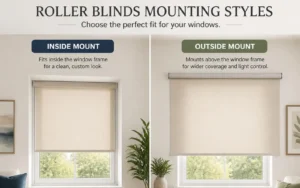
An inside mount offers a streamlined, architectural finish. The blinds sit within the recess, aligning neatly with the frame. This option works best when the window has enough depth to accommodate the headrail and slats without obstruction. However, because the blind fits within fixed boundaries, measurements must be exact. Even a few millimetres off can affect operation.
In contrast, an outside mount provides more flexibility. The blinds are mounted outside the frame, either directly on the wall or slightly above the window. This approach is ideal if your frame is shallow, uneven, or obstructed. It also helps block more light and can visually enlarge smaller windows.
When measuring:
- For inside mount, measure width at three points and use the smallest number. Measure height at three points and use the largest. Always confirm the frame depth.
- For outside mount, measure the full width of the window and add extra inches on both sides for coverage. Measure height based on where you want the blind to end.
How to Measure Width for Venetian Blinds
When it comes to installing Venetian Blinds, width is one of the most critical measurements you’ll take. Even a slight miscalculation can lead to light gaps, uneven alignment, or difficulty in operation. The way you measure width depends entirely on whether you’ve chosen an inside or outside mount.
For an inside mount, measure the width of the window recess at three different points, the top, middle, and bottom. Window frames are rarely perfectly straight, so these numbers may vary slightly.
For an outside mount, measure the full width of the window opening and then add extra space on both sides, typically 2 to 4 inches per side, to enhance light control and privacy.
How to Measure Height for Venetian Blinds
Once the width is accurately measured, the next step is determining the correct height for your Venetian Blinds. Height affects not only coverage but also how neatly the blinds stack when raised.
For an inside mount, measure the height of the window recess at three points, left, centre, and right. Just like width, frames can be slightly uneven, so these measurements may vary. In this case, always use the largest measurement to ensure the blinds fully cover the opening when lowered.
For an outside mount, measure from the exact point where the headrail will be installed, whether that’s just above the frame or closer to the ceiling down to where you want the blinds to end.
Measuring Depth and Clearance Considerations
Depth refers to the space available within your window frame and it’s especially important if you’re opting for an inside mount. Measure from the front edge of the window recess back to the glass. This tells you whether there’s enough room to accommodate the headrail and the slats when they tilt and stack.
If the depth is insufficient, the blinds may protrude awkwardly or struggle to operate properly. Clearance is equally important. Check for window handles, locks, sliding tracks, security grills, or even uneven plaster edges that might interfere with installation. Venetian Blinds need room to tilt open and closed without obstruction. Taking a few extra minutes to evaluate depth and surrounding space ensures your blinds don’t just fit they perform effortlessly every single day.
Common Mistakes to Avoid When Measuring Venetian Blinds
Measuring Old Blinds Instead of Window
Old blinds might have been trimmed, adjusted during installation, or may not have fit perfectly to begin with. Over time, window frames can also shift slightly. Measuring the blind instead of the actual window opening can lead to new Venetian Blinds that don’t fit as accurately as they should.
Using Wrong Measuring Tape
A soft fabric measuring tape, often used for tailoring, can bend, stretch, or sag, leading to inaccurate readings. For measuring Venetian Blinds, always use a sturdy metal measuring tape that stays straight and firm across the frame. It gives you sharper, more reliable numbers.
Not Measuring Multiple Points
Window frames are rarely perfectly symmetrical. Walls may not be completely straight, and corners might be slightly uneven. Measuring width or height at just one point assumes uniformity and that assumption can cause fitting issues.
Forgetting Depth Measurement
Especially for inside mounts, insufficient depth can cause blinds to protrude awkwardly or restrict the tilting movement of the slats. Without proper clearance, your Venetian Blinds may not sit flush within the frame or operate freely.
Guessing Measurements
Estimating, rounding off numbers, or assuming two windows are identical can lead to blinds that are slightly too wide, too short, or uneven once installed. Even a small difference of a few millimetres can affect how the blinds align and operate.
Why Accurate Measurements Improve Fit and Performance
Accurate measurements ensure that what you install feels tailored, balanced, and effortless to operate.
Seamless Fit
Proper width and height prevent awkward gaps on the sides or bottom, giving your blinds a clean, built-in appearance.
Better Light Control
Correct sizing reduces light leakage, especially along the edges, allowing you to control brightness exactly the way you want.
Smooth Operation
When the dimensions are accurate, the slats tilt evenly, stack neatly, and glide without friction or obstruction.
Why Choose Dooya for Motorised Venetian Blinds
With years of expertise in smart curtain and blind automation, Dooya offers solutions that deliver smooth, whisper-quiet operation and dependable long-term performance. Their motors are engineered for precision meaning your blinds respond instantly to commands without jerking or lagging. Whether you’re using a remote, wall switch, or integrating with your smart home system, Dooya’s compatibility and control options make daily operation effortless.
With Dooya, you get the perfect synergy of engineering excellence and everyday practicality, transforming your window coverings into a seamless part of your smart home experience.
FAQ
Q1. Can Venetian Blinds be installed on tiled or marble window frames?
Yes, they can. You’ll just need the right drill bits and anchors for secure installation.
Q2. Will slight wall unevenness affect the fit of Venetian Blinds?
Minor unevenness is common in most homes. That’s why measuring at multiple points is important.
Q3. Can I install Venetian Blinds over window grills?
Yes, but it usually requires an outside mount to allow proper clearance and smooth tilting of the slats.
Q4. Is it okay if my measurements are off by a few millimeters?
It might not sound like much, but even small differences can affect alignment and light control.
Q5. Do larger Venetian Blinds require special support?
For wider windows, heavier headrails or split blinds may be recommended to ensure stability and smooth operation.
Conclusion
Ordering custom Venetian Blinds isn’t just about choosing a colour or finish, it’s about getting the foundation right. Accurate measurements ensure your blinds sit perfectly aligned, block light effectively, and operate without resistance. From understanding your window type to choosing the right mount and carefully measuring width, height, and depth, every step plays a role in achieving a flawless fit.
That’s where choosing the right motor system matters. With advanced automation solutions from Dooya, your motorised Venetian Blinds move quietly, respond instantly, and integrate effortlessly into modern living.