

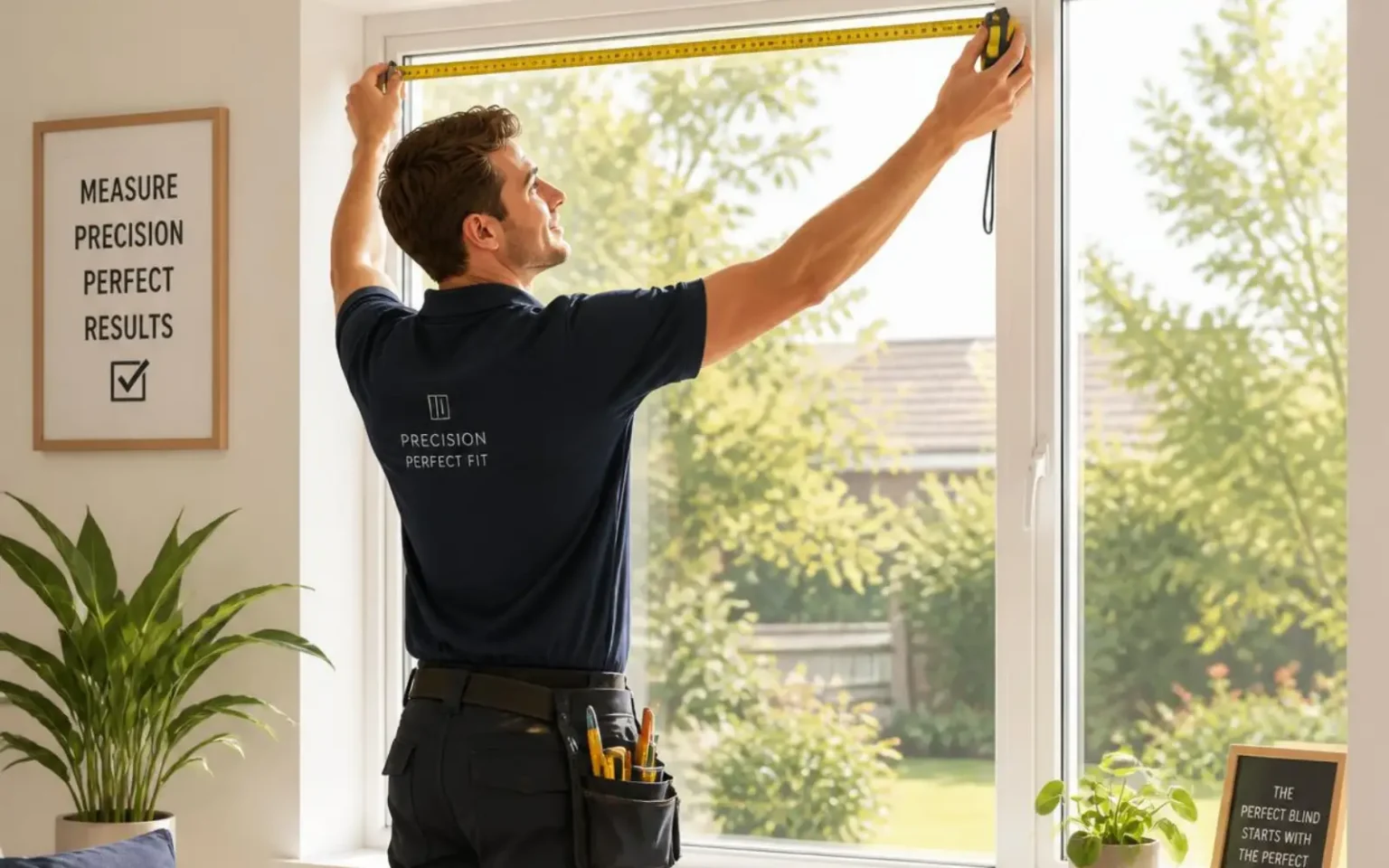
Getting the measurements right is the most critical step when ordering roller blinds. Because roller blinds are custom-fitted to each window, even a small error can result in gaps around the edges, fabric that catches on the frame, or a headrail that doesn’t fit. This guide walks you through exactly how to measure your windows for roller blinds, covering mount types, tools, and the mistakes most people make the first time around.
Why Roller Blind Measurements Need to Be Precise
Unlike curtains, which can be adjusted with extra fabric or a wider track, roller blinds are made to fit a specific opening. The fabric roll, headrail, and brackets all need to align exactly with the window recess or wall space they’re being fitted to. A measurement that’s even 5–10mm off can mean a roller blind that binds against the frame, leaves visible light gaps, or fails to close fully, so it’s worth taking the time to get it right before ordering.
Tools you’ll need:
● Steel tape measure – Fabric tape measures can stretch, leading to inaccurate readings.
● Pencil and notepad – To record each measurement as you take it.
● Step ladder – For safe access to taller or hard-to-reach windows.
● Spirit level (optional) – Useful for confirming whether a window recess is uneven.
Choosing a Mount Type for Roller Blinds
Before measuring, decide how the roller blind will be installed. This choice affects both the measuring method and how the finished blind will look and function.
| Mount Type | Description | Best For |
| Inside (Recess) Mount | Blind fits within the window recess | Clean, built-in appearance; frames with adequate depth |
| Outside (Face) Mount | Blind mounts on the wall or trim above the window | Shallow recesses, maximum light blockage, uneven openings |
| Ceiling/Top Fix Mount | Blind mounts directly to the ceiling or top reveal | Skylights, bay windows, doors without a suitable wall surface |
How to Measure for an Inside (Recess) Mount Roller Blind
- Measure the Width – Measure the width of the recess at the top, middle, and bottom of the window. Record the smallest measurement to ensure the headrail and brackets fit without rubbing against the sides.
- Measure the Drop (Height) – Measure from the top of the recess to the sill (or desired stopping point) on the left, centre, and right sides. Record the longest measurement to ensure full coverage down to the sill.
- Check the Recess Depth – Confirm there is enough depth, typically at least 45–60mm to accommodate the roller tube, brackets, and fabric without protruding or catching.
- Check for Obstructions – Look for handles, locks, alarm sensors, or window cranks that could interfere with the blind’s operation once installed.
How to Measure for an Outside (Face) Mount Roller Blind
- Measure the Width – Measure the width of the area you want covered, then add roughly 5–10cm total (split evenly on each side) to ensure the blind fully overlaps the window and minimises light gaps.
- Measure the Drop (Height) – Measure from where the top of the bracket will sit down to your desired bottom point, adding extra height above the frame if you want maximum coverage and light blockage.
- Confirm the Mounting Surface – Ensure the wall or trim area is solid enough to securely hold the brackets, particularly important for wider or motorised roller blinds.
Roller Blind Measurement Quick Reference
| Step | Inside (Recess) Mount | Outside (Face) Mount |
| Width | Smallest of 3 readings | Desired coverage + 5–10cm total |
| Drop/Height | Largest of 3 readings | Bracket point to desired bottom |
| Depth Required | 45–60mm minimum | Not applicable |
| Fit Tolerance | Precise, minimal margin | More forgiving |
Common Roller Blind Measuring Mistakes
● Using a fabric tape measure – Always use a rigid steel tape for accuracy.
● Measuring only once – Window recesses are rarely perfectly square; always take three width and three height readings.
● Applying the wrong formula – Using outside mount addition rules on an inside mount measurement (or vice versa) is one of the most common ordering errors.
● Ignoring recess depth – Insufficient depth can prevent the roller tube and brackets from fitting properly, especially with motorised headrails, which are often bulkier.
● Forgetting obstructions – Window handles or trim details can prevent the blind from rolling down fully if not accounted for.
● Rounding numbers – Round down for inside mount width and round up for outside mount coverage; avoid estimating.
Measuring Considerations for Motorised Roller Blinds
If you’re planning to install a motorised roller blind, a few extra details matter:
● Headrail Clearance – Motorised tubes are typically larger in diameter than manual ones, so confirm your recess or mounting surface has enough depth and clearance.
● Power Source Planning – For hardwired systems, measure and plan bracket placement with nearby power access in mind for battery or solar options, and confirm there’s room for the battery pack within the headrail.
● Bracket Support – Larger or wider roller blinds may need reinforced brackets to safely support the added weight of the motor.
● Control Placement – If using a wall-mounted switch or hub, factor its position into your overall installation plan.
As a global leader in motorisation technology, Dooya engineers roller blind motors designed to fit precisely within standard headrail dimensions, helping ensure a smooth, reliable installation once your measurements are finalised.
Double-Checking Before You Order
● Have a second person verify your measurements independently
● Record both width and drop in millimetres for the most accurate custom order
● Take a photo of the window alongside your written measurements for reference
● For large, oddly shaped, or motorised installations, consider consulting a professional installer to confirm measurements before ordering
Frequently Asked Questions
What’s the difference between inside and outside mount for roller blinds?
Inside mount fits within the window recess for a built-in look, while outside mount attaches to the wall or trim surrounding the window, typically offering better light blockage and more forgiving measurements.
How much recess depth do I need for an inside mount roller blind?
Most inside mount roller blinds require a minimum recess depth of 45–60mm, though motorised versions may need slightly more due to the larger tube diameter.
Do I need extra width for outside mount roller blinds?
Yes. Adding roughly 5–10cm of total width beyond the window opening helps minimise light gaps and improve privacy.
Can I still order motorised roller blinds if my recess is shallow?
In many cases, yes, an outside or top-fix mount can be used instead of an inside mount when recess depth is insufficient for a motorised headrail.
Final Thoughts
Accurate measurements are the foundation of a well-fitted roller blind, directly affecting how smoothly it operates and how well it blocks light and preserves privacy. By measuring multiple points, selecting the right mount type, and accounting for any motorisation requirements, you can avoid common ordering mistakes and ensure a clean, professional result.
If you’re planning to upgrade to motorised roller blinds, Dooya‘s precision-engineered systems are designed to fit reliably and operate smoothly across a wide range of window sizes and mounting types.