

Choosing the right window blinds and curtains can have a major impact on how a room looks, feels, and functions. Window treatments are not simply decorative additions. They help manage natural light, privacy, glare, heat, and the overall comfort of an interior. But with so many options available, an important question often arises: Should you choose curtains or blinds?
The answer depends on your window size, room requirements, interior style, desired light control, and how much convenience you want from your window coverings. Today, homeowners and businesses can also take window treatments a step further with motorised automation.
This guide explains how to choose between curtains and blinds, how to measure your windows correctly, and how automation can make everyday window control easier.
Why Choose the Right Window Blinds and Curtains?
Windows influence the amount of sunlight, heat, and outside visibility entering a room. The right treatment allows you to control these factors while complementing your interior design.
Well-planned window blinds and curtains can help with:
● Natural light control
● Privacy
● Glare reduction
● Solar heat management
● Interior aesthetics
● Flexible room ambience
● Convenience and accessibility
● Smart-home integration
Different rooms also have different requirements. A bedroom may need stronger privacy and blackout performance, while a living room may benefit from softer daylight and an open view.
Curtains vs. Blinds: What Is the Difference?
Curtains and blinds perform many of the same basic functions, but their construction and operation are different.
Curtains generally consist of fabric panels that move horizontally along a rod or track. They can add softness, texture, colour, and visual warmth to an interior.
Blinds, on the other hand, use a structured covering that may roll, fold, tilt, or move vertically or horizontally depending on the design. Roller, venetian, zebra, vertical, honeycomb, and other blind styles offer different approaches to light and privacy control.
Curtains or Blinds: Quick Comparison
| Feature | Curtains | Blinds |
| Appearance | Soft and decorative | Clean and structured |
| Light control | Depends on fabric and lining | Often highly adjustable |
| Privacy | Good | Excellent with suitable materials |
| Fabric choices | Very extensive | Available in multiple fabrics and finishes |
| Maintenance | Depends on fabric | Generally easy to maintain |
| Large windows | Excellent | Excellent with suitable systems |
| Layering | Easy | Can be paired with curtains |
| Motorisation | Available | Available |
| Smart-home integration | Available | Available |
There is also no requirement to choose only one. Layered window blinds and curtains can combine the practical advantages of blinds with the decorative qualities of curtains. Dooya specifically describes combining a functional blind with curtains as a way to achieve both precise light control and a softer finished appearance.
How to Choose Between Curtains and Blinds
Before selecting a window treatment, consider the following factors.
1. Consider the Room
The function of the room should influence your decision.
- Bedrooms: Consider blackout blinds, blackout curtains, or a combination for privacy and darkness.
- Living rooms: Light-filtering blinds with curtains can provide flexibility while maintaining a comfortable appearance.
- Home offices: Blinds can provide precise glare control, particularly when working near windows or using computer screens.
- Hospitality and commercial spaces: Motorised systems can make it easier to operate multiple window treatments consistently.
2. Think About Light Control
Ask yourself how much natural light you want throughout the day. If you want precise adjustment, options such as roller blinds or venetian blinds can provide greater control. Curtains can provide broader coverage and softer light filtering depending on their fabric and lining. For particularly bright rooms, combining blinds with curtains provides multiple levels of light control.
3. Consider Privacy
For bedrooms, bathrooms, offices, and windows facing neighbouring buildings, privacy can be a major consideration. Blinds can be adjusted to control visibility while still allowing some daylight into the room. Curtains can provide complete coverage when closed.
4. Consider the Window Size
Large or floor-to-ceiling windows require careful consideration of the covering’s weight, dimensions, operating mechanism, and installation space. Motorisation can be particularly useful when several large window treatments need to be operated together.
How to Measure Your Windows for Blinds and Curtains
Accurate measurements are essential for achieving a professional finish.
While curtains can provide some flexibility because the fabric extends beyond the window, blinds often require more precise measurements because the blind mechanism and fabric must fit the intended installation area. Dooya’s measurement guidance notes that inaccurate measurements can result in gaps, frame interference, or fitting problems.
Measuring for Blinds
Depending on the installation, you generally need to measure:
● Window width
● Window height
● Recess depth, if applicable
● Frame dimensions
● Available space for brackets
● Window handles and other obstructions
Measure the width at the top, middle, and bottom of the window. Similarly, measure the height at multiple points. If the measurements differ, do not automatically assume that the window is perfectly square.
Measuring for Curtains
Curtain measurement involves more than simply measuring the glass.
Consider:
- Track or rod width: Decide how far the curtain should extend beyond the window.
- Curtain drop: Measure from the intended track or rod position to the desired finishing point.
- Stacking space: Allow sufficient space at the sides for curtains when they are open.
- Fullness: The amount of fabric required depends on the desired appearance and curtain style.
- Track configuration: Straight, curved, and other track arrangements may require different planning.
For motorised curtains, track length, curtain weight, and track design are important factors when selecting the motor. Dooya recommends considering curtain weight, track length and design, control preferences, and power source when selecting a curtain motor.
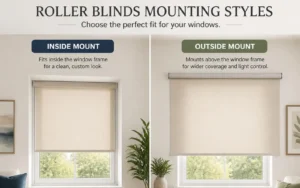
Inside Mount vs. Outside Mount Blinds
If you are choosing blinds, you may also need to decide between an inside and outside installation.
Inside Mount
The blind is fitted within the window recess.
Advantages:
● Clean, integrated appearance
● Highlights the window frame
● Uses less surrounding wall space
● Suitable for appropriately deep recesses
Outside Mount
The blind is installed outside the window recess, generally on the wall or surrounding frame.
Advantages:
● Useful for shallow recesses
● Can provide greater window coverage
● Can help reduce light gaps around the edges
● Useful when window hardware interferes with an inside installation
The correct choice depends on the window design, available space, desired appearance, and functional requirements.
When Should You Combine Window Blinds and Curtains?
Sometimes the best solution is not choosing between curtains and blinds but using both.
A popular layered arrangement is:
Roller Blind + Curtain
The roller blind can provide everyday light and privacy control, while the curtain adds softness, additional coverage, and a decorative finish.
Layering can be especially useful for:
● Bedrooms
● Living rooms
● Large windows
● Floor-to-ceiling glass
● Luxury residential interiors
● Hotels and hospitality spaces
Dooya’s window-covering guidance highlights layered treatments as a way to combine the functional performance of blinds with the visual warmth of curtains.
What Does Window Automation Mean?
Window automation replaces repeated manual operation with motorised control.
Instead of manually pulling a curtain or adjusting a blind, a motor moves the window treatment according to your chosen command or schedule.
Depending on the system, users may be able to control their window blinds and curtains through:
● Remote controls
● Wall switches
● Smartphone applications
● Voice assistants
● Automated schedules
● Compatible sensors
● Smart-home systems
Dooya’s home automation solutions use a combination of bridges, motors, and cloud connectivity to provide smart control of curtains and blinds.

How Do Motorised Window Blinds and Curtains Work?
The automation process typically involves several stages.
Step 1: Assess the Window
The window dimensions, covering type, fabric or blind material, and preferred operating method are evaluated.
Step 2: Select the Motor
The appropriate motor depends on factors such as blind size, curtain weight, track configuration, and required control method. For roller blinds, the motor is typically integrated into the roller tube. For curtains, a motor works with the curtain track to move the fabric panels.
Step 3: Install the System
Brackets, tracks, motors, and other required components are installed and connected to the selected power source.
Step 4: Pair and Configure
The motor can be paired with the chosen remote, switch, app, or compatible smart-home system. Travel limits can also be configured for accurate opening and closing.
Step 5: Test the System
The completed installation should be tested for smooth movement, correct stopping positions, and control response.
Benefits of Automating Window Blinds and Curtains
Motorisation can make window treatments more convenient while supporting consistent control.
Convenience
Open or close multiple treatments without manually adjusting each one.
Better Control
Adjust the amount of natural light entering a room throughout the day.
Accessibility
Motorised operation can be particularly useful for large, high, or difficult-to-reach windows.
Scheduling
Depending on the system, you can schedule window treatments to operate at particular times.
Smart-Home Integration
Compatible systems can connect window treatments with other smart-home functions.
Cleaner Appearance
Motorised solutions can reduce the need for manually operated cords and chains, creating a more streamlined appearance.
Dooya curtain motors offer options including remote, mobile app, wall-switch, and voice-assistant control, while certain systems also provide manual override functionality during power interruptions.
What Should You Consider Before Automating Your Windows?
Automation should be planned before installation rather than added as an afterthought.
Consider:
● Window dimensions
● Blind or curtain type
● Curtain weight
● Track length
● Motor capacity
● Power source
● Control method
● Smart-home compatibility
● Installation access
● Manual override requirements
For large installations, it is particularly important to match the motor to the actual load and application rather than selecting a system based only on appearance.
Why Choose Dooya for Automated Window Treatments?
Dooya develops motorised solutions for curtains and blinds designed around smooth operation, control flexibility, and smart-home integration. Its range includes curtain motors, tubular motors, Wi-Fi motors, control systems, and other automation solutions for different window-covering applications.
Depending on the selected solution, Dooya systems can provide:
● Smooth and quiet operation
● Remote control
● Smartphone control
● Wall-switch operation
● Voice control through compatible systems
● Scheduling
● Manual override on selected systems
● Smart-home integration
● Solutions for residential and commercial applications
Final Thoughts
Choosing between window blinds and curtains does not have to be complicated. Start by considering the purpose of the room, amount of sunlight, privacy requirements, window dimensions, interior style, and desired level of convenience.
Blinds can provide structured and precise light control, while curtains bring softness, texture, and decorative appeal. For many interiors, combining both provides a practical balance of functionality and design.
Once you have selected the right window treatment, accurate measurement and installation are essential. And if you want to make everyday operation easier, motorisation can transform traditional window coverings into convenient smart-home features.
With the right combination of window blinds and curtains and intelligent automation, your windows can become more than decorative elements; they can contribute to a comfortable, private, connected, and thoughtfully designed interior.
Frequently Asked Questions About Window Blinds and Curtains
Are blinds better than curtains?
Neither is universally better. Blinds provide different levels of light and privacy control, while curtains offer softness, coverage, and decorative flexibility. The right choice depends on the room and your requirements.
Can I use window blinds and curtains together?
Yes. Combining window blinds and curtains provides greater flexibility for light control, privacy, insulation, and interior styling.
How accurately should I measure my windows?
Measurements should be taken carefully at multiple points, particularly for blinds. Small measurement errors can create fitting problems or unwanted gaps.
Can existing curtains be motorised?
In many cases, an existing curtain setup may be adaptable, but compatibility depends on the track, curtain weight, configuration, and motor requirements. A professional assessment can determine the appropriate solution.
Are motorised window blinds suitable for large windows?
Yes. Motorisation can be especially useful for large, high, or difficult-to-reach windows and for installations involving multiple coverings.
Can window blinds and curtains be controlled by a smartphone?
Compatible Dooya systems can provide smartphone control, along with other control options depending on the motor and automation setup.